By Mike Lera
How do you make a 200-year-old story like Frankenstein into a feature film when it’s been adapted into countless movies, TV shows, plays, graphic novels, animated programs, comic books and short films for well over a century?
The answer is simple: Guillermo del Toro.
Just as 2005’s King Kong was Peter Jackson’s “love letter” to a legendary beast, Guillermo del Toro’s Frankenstein can be considered the monster filmmaker’s greatest “passion project” to date, and like the iconic jaded green creature, is a wonderfully and meticulously stitched masterpiece brought to life with vibrance and electricity.
Like a dreamy, grim fairy tale or stage play, this fresh reimagining of the famous Mary Shelley story captures much of the spirit, tone and lore of the novel as well as terrific nods to the 1931 original feature that devoted fans of the character would appreciate, and because del Toro is renowned for creating Frankenstein monster-like characters throughout most of his films, it makes perfect sense that he would take on this new outing of the notorious “mad scientist”, Victor Frankenstein.
“I am more attracted now to making movies about people that are full of villainy, because I think that it’s a more real way of seeing the world,” del Toro told Tudum magazine.
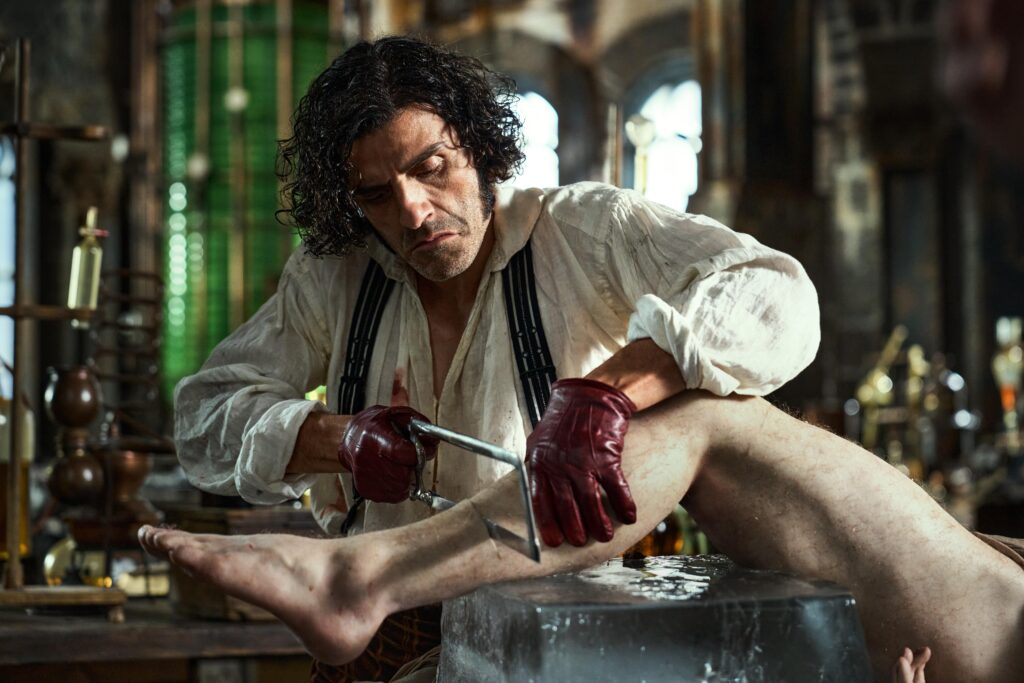
While del Toro remains mostly true to the book, he courageously, yet carefully puts his own cinematic spin on the familiar narrative. For instance, the film delves deeper into the childhood of Victor Frankenstein (Oscar Isaac), raised by an overbearing, abusive father (Charles Dance) bent on making certain his son carries on his family name as a physician. When Victor’s mother, Claire – his only true source for love and compassion – tragically dies from giving birth to his younger brother William (Felix Kammerer), young Victor is left utterly heartbroken and alone, and it is then that he sets out to conquer death by creating life. A man so terrified and angry at nature that he tries to control it by playing God.Of course, where Dr. Frankenstein is the brain of the film, his “monster” (Jacob Elordi) is the heart of the piece. A seven-foot muscular creature made up of parts of fallen soldiers and doomed criminals, del Toro’s monster is portrayed heavily as a “lost soul” who consistently wins the viewer’s empathy throughout the film. Unlike other adaptations, Victor spends a considerable amount of time trying to teach and train his newborn “child” during post creation. Yet like his own father, Victor lacks patience, understanding, and above all, love, and therefore decides to destroy his work when his expectations are not met. Thus, this leads to one of the biggest themes of the film (and in life) – a brilliant, prideful creator without compassion and responsibility is perhaps the greatest monster of all!
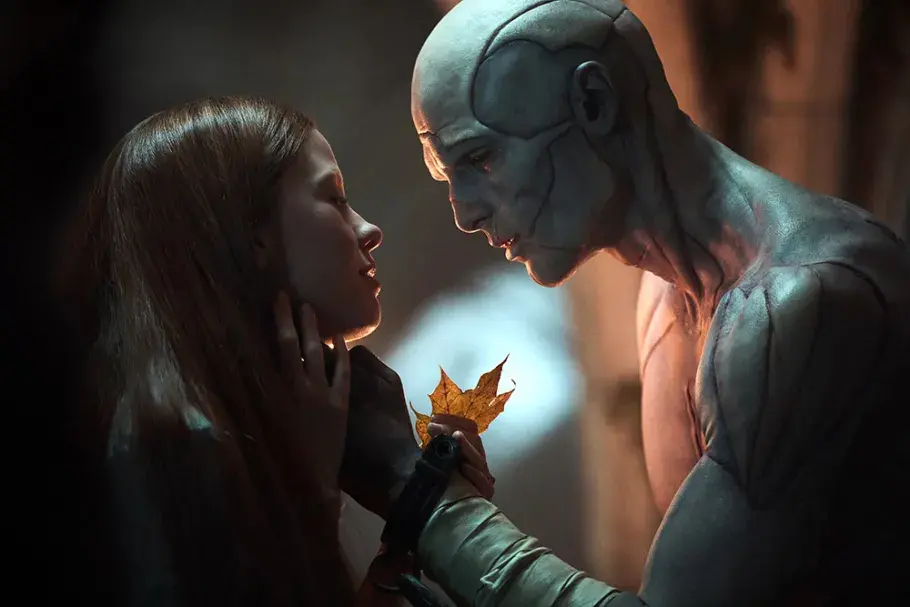
Although much of the creature’s humanity is exhibited without words in the film, del Toro strikes a good balance between Karloff’s limited vocabulary (“Friend”) and the monster in Shelley’s novel (“I have love in me the likes of which you can scarcely imagine and rage the likes of which you would not believe”) Through the monster’s anguish and pain when being abandoned by his maker and eventually scorned by society, he shows us that stopping something as horrible as death doesn’t mean a person may not one day desire it.
Mia Goth’s performance as Elizabeth (and as Claire Frankenstein) is, without doubt, the life blood of the film, her character representing the beauty and humanity that Victor lacks, needs, and so desperately wants deep inside. During one extraordinary scene, Elizabeth takes it upon herself to befriend the creature, offering him warmth and comfort, gradually drawing close to him emotionally and physically. Yet del Toro cunningly pulls away just when we think things can get sensual, offering us just enough to see how powerful both beauty and suffering are simultaneously real and need to coexist.
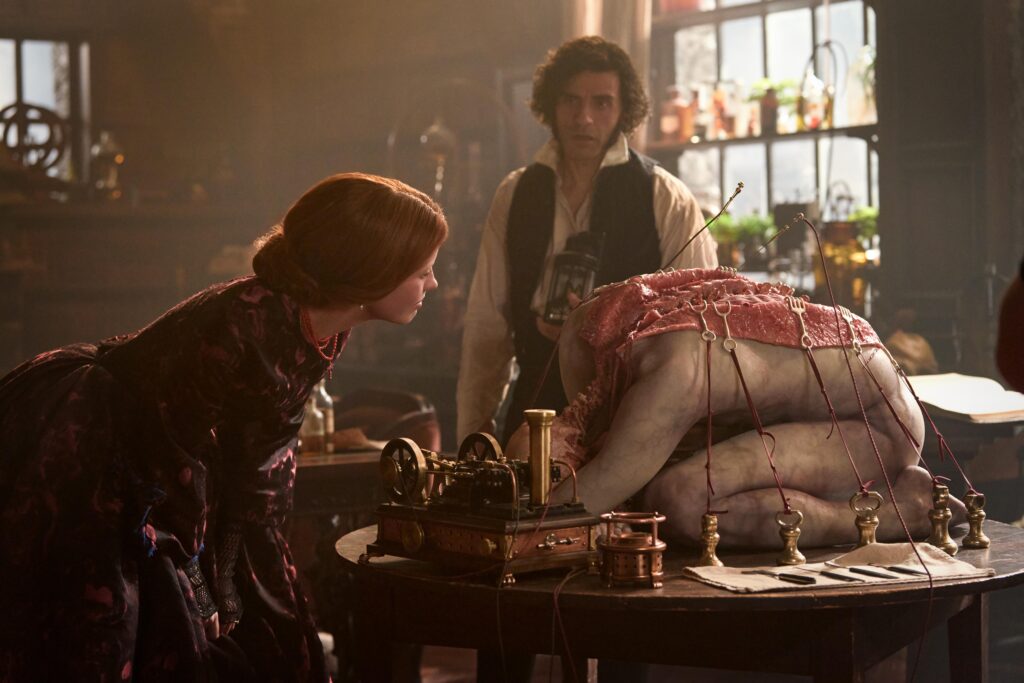
Aside from the film’s lavish costumes and set designs that immediately send us back to 19th century Europe, including del Toro’s meticulous attention to such iconographies as Frankenstein’s tower and laboratory, the epic is also laced with religious symbolism as well, i.e. Victor’s constant horrifying nightmares of an “angel of death”. In one scene during pre creation, the monster is laid against a wooden platform with arms spread out, crucifix-style – a clear and clever metaphor for both miracle and martyr. When Victor’s experiment is over, he says, “It is done”, as Christ said on the cross.
However, like our flawed “protagonist” Frankenstein, del Toro’s film isn’t without “quirks”.
The final moments between Victor and his creation aboard an expedition ship, for instance, seems hurried for the sake of finishing the film and could have been drawn out more, as this sequence has always been a key and crucial element within the plot.
Certain lines in the film are a bit obvious and “on the nose”. At the film’s climax, for example, Victor is told, “You are the monster!” after we had spent almost the entire movie already “seeing” this. Other dialogue lean toward the “cheesy” side, such as the creature (when asking Victor for a mate) saying, “We can be monsters… together!” Ughh.
The film opens with perhaps the best gritty action/horror sequence of any Frankenstein movie, and though there’s enough thrills and chills throughout the film to satisfy viewers, those with an appetite for blood and guts every 15 minutes and expecting more of the introductory scene may find themselves a little hungry.
In the end, Frankenstein stands as del Toro’s own “love letter” to not only Mary Shelley’s monster, but to other “monsters” in need of compassion and acceptance, and can best be summed up in Elizabeth’s line to the lonely creature, “To be lost and to be found… that is the lifespan of love,” demonstrating the fragile need for human connection.
Score: 9.5/10
END